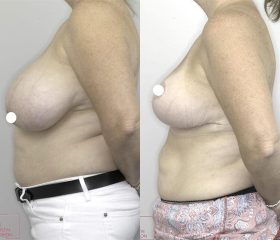
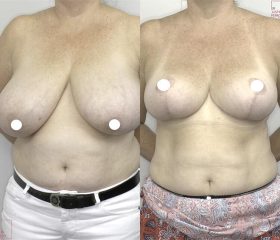
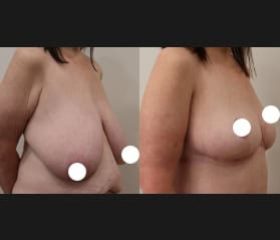
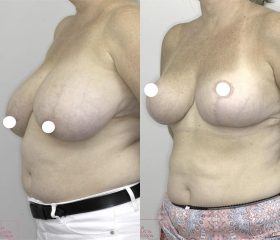
Reducing, reshaping and lifting heavy breasts with Specialist Plastic Surgeon Dr Justin Perron.
Breast reduction surgery in Brisbane
Breast reduction surgery (reduction mammoplasty, also spelt mammaplasty) removes excess breast tissue, fat and skin, then reshapes and lifts what remains so the breasts sit in better proportion to your frame. Dr Justin Perron is a Specialist Plastic and Reconstructive Surgeon (FRACS) who performs breast reduction in Brisbane, consulting from Herstellen Clinic in Spring Hill.
Some women come to us because of neck, shoulder or back pain. Others are worn down by bra straps that dig in, rashes under the breast that keep coming back, or the difficulty of exercising comfortably. Often it is a mix. This page walks through who the operation may suit, how it is done, what recovery looks like, the costs and Medicare rules, and the risks you should know about before you decide anything.
| Procedure | Breast reduction (reduction mammoplasty) |
| Anaesthetic | General anaesthetic |
| Operating time | Usually around 2 to 4 hours, depending on technique and the amount of tissue removed |
| Hospital stay | Day surgery or one night in hospital, depending on your health and procedure |
| Time off work | Usually 1 to 2 weeks for desk-based work; longer for physical jobs |
| Exercise | Walking from day one; light exercise from about 2 weeks; most activity by about 6 weeks, as advised |
| Final shape | Breasts settle over roughly 6 to 12 months; scars continue to fade for 12 months or more |
| Medicare | A rebate may apply if you meet the MBS clinical criteria (see below) |
| Where | Consultations at Herstellen Clinic, 490 Boundary Street, Spring Hill; surgery at accredited Brisbane hospitals |
A breast reduction is an operation that makes the breasts smaller, lighter and higher on the chest. Dr Perron removes a planned amount of glandular tissue, fat and skin, moves the nipple and areola up to a new position, and can make the areola smaller if it has stretched. The remaining tissue is shaped into a more lifted breast mound.
Large, heavy breasts (macromastia) are not just a cosmetic matter for many women. The weight can pull on the neck and shoulders, and skin under the breast fold can stay damp and irritated. When these problems are documented, breast reduction may be treated as a medically necessary procedure, which affects Medicare and private health cover.
You might want to talk with Dr Perron or your GP if you notice some of the following:
These symptoms can have other causes too, so it helps to see your GP first. A GP can also write the referral you need for your consultation.
You may be a suitable candidate if large breasts are causing physical symptoms or getting in the way of daily life, and you are in good general health. Dr Perron will usually look at the following:
Not everyone is a good fit for surgery. If Dr Perron feels another option would serve you better, or that the timing is not right, he will tell you.
Both operations lift the nipple and reshape the breast. The difference is how much tissue is taken away.
| Breast reduction | Breast lift (mastopexy) | |
|---|---|---|
| Main aim | Reduce size and weight, then lift | Lift and reshape without much change in volume |
| Tissue removed | Gland, fat and skin | Mainly skin |
| Usual reason | Heavy breasts causing physical symptoms | Sagging after pregnancy, breastfeeding or weight loss |
| Medicare | May be eligible if MBS criteria are met | Item rules differ; often not eligible |
If your breasts have dropped but are not especially heavy, a breast lift (mastopexy) may be more suitable. Dr Perron can explain which option fits your situation at your consultation.
DISCLAIMER: Please be advised that each patients results will vary and specific outcomes are not guaranteed. Please be aware that all procedures carry risks, therefore, we encourage patients to consult with their regular GP and Qualified Specialist Plastic Surgeon before considering surgery.


You can see more patient photos in our breast reduction before and after gallery.
Breast reduction is performed under general anaesthetic. The technique is chosen for your breast size, skin quality, nipple position and goals. There are two main decisions: the incision pattern (which determines where the scars sit) and the pedicle (the bridge of tissue that keeps the nipple alive while it is moved).
The nipple and areola stay attached to a column of tissue that carries their blood and nerve supply. Common versions are the inferior pedicle (based at the bottom of the breast), and the superior or superomedial pedicle (based at the top or upper inner breast). Each has trade-offs for shape, how long the result holds up, and the chance of keeping nipple sensation and the ability to breastfeed. For very large reductions, the nipple may need to be removed and replaced as a skin graft (free nipple graft), which means sensation and breastfeeding are lost.
At the end of the operation the incisions are closed in layers with stitches, and dressings and a support bra are applied. A small drain is sometimes used for a short time.
Bring your GP referral, a list of medicines and supplements, and any recent breast imaging. Dr Perron will ask about your symptoms and health history, examine and measure your breasts, take clinical photographs, and talk you through the technique he recommends, where the scars will be, the risks and the costs. You will get written information and a quote to take home.
Depending on your age and history, you may be asked to have a mammogram or breast ultrasound before surgery. Any removed tissue is routinely sent to pathology.
If your breast reduction is considered cosmetic rather than medically necessary, Medical Board of Australia guidelines apply. These require a referral, at least two consultations before surgery, screening for body dysmorphic disorder, and a cooling-off period of at least seven days before you commit to surgery.
You will wake in the recovery area with dressings and a surgical bra in place. Expect tightness, swelling and some bruising. Pain is usually managed with tablets. Dr Perron and the nursing team will check your wounds and nipple circulation, and you will be encouraged to get up and walk soon after surgery to lower the risk of blood clots.
Everyone heals at a different pace, so treat this as a general guide. Dr Perron will give you written instructions for your own recovery.
| Time after surgery | What to expect |
|---|---|
| First 48 hours | Swelling, tightness and discomfort, managed with prescribed pain relief. Rest at home with your upper body raised. Short walks around the house. |
| Week 1 | Bruising peaks then starts to fade. Keep dressings dry and intact unless told otherwise. First wound check. No lifting heavier than a full kettle. |
| Weeks 1 to 2 | Many people return to desk work. Driving is possible once you are off strong pain relief and can turn the wheel and brake suddenly without pain. |
| Weeks 2 to 6 | Light exercise such as walking and stationary cycling. Keep wearing your surgical bra day and night. Avoid lifting, pushing and upper body exercise. |
| Week 6 | Review appointment. Most patients gradually return to the gym, running and swimming once cleared. Sleeping on your side is often more comfortable from here. |
| 3 to 6 months | Swelling continues to settle and the breasts soften and drop into a more natural shape. |
| 6 to 12 months and beyond | Final breast shape becomes clearer. Scars fade from pink to paler over 12 to 18 months or longer. |
Every breast reduction leaves permanent scars. Where they sit depends on the incision pattern: around the areola, down the front of the breast and, with the anchor pattern, along the fold underneath. They are usually hidden by a bra or bikini top but will be visible without clothing.
Scars are often red or raised for the first few months before they flatten and fade. How they mature depends on your skin type, genetics, smoking, tension on the wound and how well you follow scar care advice. Dr Perron may recommend silicone gel or tape and sun protection once the wounds have healed. Some people form thickened (hypertrophic) or keloid scars, which may need extra treatment. Read more about scar revision.
Many patients report less neck and shoulder strain, fewer skin problems and more comfort when exercising after breast reduction, though individual results vary and some symptoms may have other causes. Your breasts will continue to change with age, weight, pregnancy and hormones.
Keep up with routine breast screening. Scar tissue and fat necrosis can change how a mammogram or ultrasound looks, so let your radiologist know you have had surgery. A new baseline scan some months after surgery can be helpful for comparison.
Related procedures: breast lift (mastopexy), breast augmentation and implant surgery, fat grafting, breast reconstruction, male breast reduction (gynaecomastia) and tummy tuck (abdominoplasty).
Dr Perron’s surgeon’s fee for breast reduction typically ranges from $6,000 to $10,000. This is the surgeon’s fee only. Your total cost will be higher once other fees are added, and you will get a written, itemised quote after your consultation.
If you meet Medicare criteria and hold suitable private health cover, part of these costs may be rebated, which can reduce your out-of-pocket amount considerably. Your quote will show which items attract a rebate. For a fuller breakdown, see how breast reduction costs are calculated.
Breast reduction may attract a Medicare rebate when it is medically necessary. Under the Medicare Benefits Schedule (MBS):
To claim, you need a current referral from your GP (or another specialist), and your symptoms need to be documented. Dr Perron will assess whether your situation appears to meet the criteria at your consultation. A reduction done purely for appearance is not eligible for a Medicare rebate. Our guide to checking your Medicare rebate eligibility explains the referral and documentation steps.
For private health insurance, look for the clinical category called “Breast surgery (medically necessary)” on your policy. Check your waiting periods and excess with your fund before booking. Our team can give you the item numbers so you can ask your fund what they will cover.
All surgery carries risk. Most people recover without major problems, but complications do happen, and some may need further treatment or another operation. Risks are higher in people who smoke, have a higher BMI or have diabetes.
General surgical risks include bleeding, infection, reactions to the anaesthetic, blood clots in the legs (deep vein thrombosis) or lungs (pulmonary embolism), and chest infection.
Risks specific to breast reduction include:
Dr Perron will go through your personal risk profile at your consultation. For more detail, see our page on surgical risks.
These guides go into more detail on the questions patients ask us most often about breast reduction.
It can be. Medicare item 45523 covers a breast reduction on both sides for women with macromastia and neck or shoulder pain. Item 45520 covers a one-sided reduction linked to breast cancer or a developmental breast abnormality. You need a GP referral, and reductions done purely for appearance are not covered.
Dr Perron’s surgeon’s fee for breast reduction typically ranges from $6,000 to $10,000. Anaesthetist, assistant, hospital and garment fees are extra. If you meet Medicare criteria and have suitable private health cover, rebates may reduce your out-of-pocket cost. You will get an itemised quote after your consultation.
People with large breasts causing symptoms such as neck, back or shoulder pain, bra strap grooves or skin rashes may be suitable. You should be in good health, at a stable weight, a non-smoker, not pregnant or breastfeeding, and have realistic expectations about scars and results.
Yes. You need a referral from your GP or another specialist to see Dr Perron. A current referral is also needed to claim Medicare rebates. If your surgery is considered cosmetic, Medical Board of Australia guidelines require a referral, two pre-operative consultations and a cooling-off period of at least seven days.
It depends on your starting size, frame and how much tissue can be safely removed. Many patients go down a few cup sizes, but bra sizing is inconsistent between brands, so Dr Perron plans the reduction around proportion and comfort rather than a promised cup size. Bringing reference photos can help.
The 45:55 rule comes from research on breast shape. It suggests that a natural-looking breast often has about 45 per cent of its volume above the nipple and 55 per cent below it. Surgeons may use it as a loose planning guide, but your own anatomy and goals matter more.
You will be asleep under general anaesthetic during surgery, so you will not feel it. Afterwards, most people describe tightness, soreness and swelling rather than sharp pain, and it is usually managed with tablets. Discomfort tends to ease noticeably over the first one to two weeks.
Most people take one to two weeks off desk-based work and avoid strenuous exercise and heavy lifting for about six weeks. Swelling settles gradually over three to six months, and the final shape and scar appearance can take 12 months or longer.
Driving is usually possible after about one to two weeks, once you are off strong pain medicine and can brake hard and turn the wheel comfortably. Walking starts straight away, light exercise from about two weeks, and most other activity once Dr Perron clears you, often around six weeks.
Most patients wear a soft, front-opening, wire-free support bra day and night for about six weeks. It helps control swelling and supports the breasts while the internal stitches heal. Dr Perron will tell you when you can switch to underwire bras, which is usually after three months.
Yes. All breast reductions leave permanent scars, usually around the areola, down the front of the breast and sometimes in the fold underneath. They often start red and raised, then flatten and fade over 12 to 18 months. Most can be covered by a bra or bikini top.
Changes in nipple sensation are common. Many people find feeling returns over weeks to months, but for some the change is permanent, with either reduced or heightened sensation. The risk is higher with larger reductions and is unavoidable with a free nipple graft.
Some women can, but breastfeeding may be reduced or not possible after surgery, and nobody can guarantee it. Techniques that keep the nipple attached to the underlying tissue give a better chance. If having children and breastfeeding matter to you, raise it at your consultation.
The tissue removed does not grow back, so the reduction is long-lasting. Your breasts will still change with ageing, gravity, weight gain or loss, pregnancy and hormones. Keeping a stable weight helps maintain the result over time.
Waiting is often recommended. Pregnancy, breastfeeding and big weight changes can alter breast size and shape after surgery. That said, if your symptoms are significant now, surgery before children can still be reasonable. Dr Perron will help you weigh up the timing.
A higher BMI raises the risk of wound problems, infection and blood clots, and some hospitals and anaesthetists set limits for day or overnight surgery. Dr Perron will look at your overall health, not just a number, and may suggest weight loss first if it would make surgery safer.
It depends on your age, family history and breast health. Many patients over 40, or those with risk factors, are asked to have a mammogram or ultrasound beforehand. Removed tissue is also sent to pathology. A new baseline scan after surgery helps with future screening.
Yes, in some cases. Liposuction to the sides of the chest is commonly done at the same time. Some patients ask about combining it with a tummy tuck. Combining operations lengthens anaesthetic time and recovery, so Dr Perron will advise whether it is safe for you.
Choosing a surgeon is one of the most important decisions you will make. Here is what you can check about Dr Justin Perron:
Dr Perron takes time to explain your options, including when surgery may not be the right choice. To book a consultation, ask your GP for a referral and call 07 3861 8800, or book online via HotDoc.
The information on this page is general in nature and is not a substitute for personal medical advice. Any surgical or invasive procedure carries risks. Before proceeding, you should seek a second opinion from an appropriately qualified health practitioner. Individual results vary and specific outcomes cannot be guaranteed. We encourage you to speak with your GP and a Specialist Plastic Surgeon about your circumstances, including the risks, recovery and costs, before deciding on surgery. Medicare and private health insurance eligibility depends on your individual situation and current MBS criteria.
Dr Justin Perron, MBBS FRACS (Plastics), Specialist Plastic and Reconstructive Surgeon, AHPRA Registration No. MED0000959827.
Have a question about one of our procedures? Simply enter your details in the form below and one of our friendly team members will be in touch ASAP.
490 Boundary Street
Spring Hill QLD 4000